Phaeophyceae: Brown Algae
Examples: Laminaria and Saccharina, Fucus, Sargassum muticum, brown seaweeds
 The
brown colour of these algae results from the dominance of the
xanthophyll pigment fucoxanthin, which masks the other pigments,
Chlorophyll a and c (there is no Chlorophyll b), beta-carotene and other
xanthophylls. Food reserves are typically complex polysaccharides,
sugars and higher alcohols. The principal carbohydrate reserve is
laminaran, and true starch is absent (compare with the green algae). The
walls are made of cellulose and alginic acid, a long-chained
heteropolysaccharide.
The
brown colour of these algae results from the dominance of the
xanthophyll pigment fucoxanthin, which masks the other pigments,
Chlorophyll a and c (there is no Chlorophyll b), beta-carotene and other
xanthophylls. Food reserves are typically complex polysaccharides,
sugars and higher alcohols. The principal carbohydrate reserve is
laminaran, and true starch is absent (compare with the green algae). The
walls are made of cellulose and alginic acid, a long-chained
heteropolysaccharide.
There are no known unicellular or colonial representatives; the simplest plant form is a branched, filamentous thallus. The kelps are the largest (up to 70 m long) and perhaps the most complex brown algae, and they are the only algae known to have internal tissue differentiation into conducting tissue; there is, however, no true xylem tissue as found in the 'higher' plants.
 Most
brown algae have an alternation of haploid and diploid generations. The
haploid thalli form isogamous, anisogamous or oogamous gametes and the
diploid thalli form zoospores, generally by meiosis. The haploid
(gametangial) and diploid (sporangial) thalli may be similar
(isomorphic) or different (heteromorphic) in appearance, or the
gametangial generation may be extremely reduced (Fucales). The brown
Giant Kelp Macrocystis pyrifera
(top) is harvested off the coasts of California for feeding abalone.
It used to be used for alginate extraction, but this now mostly comes
from Atlantic Ascophyllum nodosum and Laminaria hyperborea. Alginates,
derivatives of alginic acids, are used commercially for toothpastes,
soaps, ice cream, tinned meats, fabric printing, and a host of other
applications. It forms a stable viscous gel in water, and its primary
function in the above applications is as a binder, stabilizer,
emulsifier, or moulding agent. Saccharina japonica, formerly Laminaria, and other species of the genus are grown on ropes in China, Korea and Japan for food and alginate production. Undaria pinnatifida is
also cultivated in Japan, Korea and China for production of Wakame, a
valuable food kelp. Small amounts are also grown in Atlantic France for
the European market.
Most
brown algae have an alternation of haploid and diploid generations. The
haploid thalli form isogamous, anisogamous or oogamous gametes and the
diploid thalli form zoospores, generally by meiosis. The haploid
(gametangial) and diploid (sporangial) thalli may be similar
(isomorphic) or different (heteromorphic) in appearance, or the
gametangial generation may be extremely reduced (Fucales). The brown
Giant Kelp Macrocystis pyrifera
(top) is harvested off the coasts of California for feeding abalone.
It used to be used for alginate extraction, but this now mostly comes
from Atlantic Ascophyllum nodosum and Laminaria hyperborea. Alginates,
derivatives of alginic acids, are used commercially for toothpastes,
soaps, ice cream, tinned meats, fabric printing, and a host of other
applications. It forms a stable viscous gel in water, and its primary
function in the above applications is as a binder, stabilizer,
emulsifier, or moulding agent. Saccharina japonica, formerly Laminaria, and other species of the genus are grown on ropes in China, Korea and Japan for food and alginate production. Undaria pinnatifida is
also cultivated in Japan, Korea and China for production of Wakame, a
valuable food kelp. Small amounts are also grown in Atlantic France for
the European market.

About 16,000 tonnes of Ascophyllum nodosum (above, Feamainn bhuí in Irish, referring to the yellow colour in summer) are harvested each year in Ireland, dried and milled in factories at Arramara Teo., Cill Chiaráin (Kilkerrin), Co. Galway; and some 3,000 t of the resulting seaweed meal is exported and processed in Scotland for the production of alginic acid. Laminaria hyperborea stipes (sea rods) are harvested in Norway and used to be collected in drift in Scotland and Ireland. The rods are used for the manufacture of high-grade alginates. Other brown algae are used for the extraction of agricultural sprays ('liquid seaweed extracts'). These extracts are used at low concentrations on crops and their hormone-like activities are thought to be due to betaines, cytokinenins, etc. In some areas, like the west of Ireland and Scotland, kelps and other brown algae are gathered as a fertiliser for land
Characteristics
The
brown colour of these algae results from the dominance of the
xanthophyll pigment fucoxanthin, which masks the other pigments,
Chlorophyll a and c (there is no Chlorophyll b), beta-carotene and other
xanthophylls. Food reserves are typically complex polysaccharides,
sugars and higher alcohols. The principal carbohydrate reserve is
laminaran, and true starch is absent (compare with the green algae). The
walls are made of cellulose and alginic acid, a long-chained
heteropolysaccharide. There are no known unicellular or colonial representatives; the simplest plant form is a branched, filamentous thallus. The kelps are the largest (up to 70 m long) and perhaps the most complex brown algae, and they are the only algae known to have internal tissue differentiation into conducting tissue; there is, however, no true xylem tissue as found in the 'higher' plants.
Most
brown algae have an alternation of haploid and diploid generations. The
haploid thalli form isogamous, anisogamous or oogamous gametes and the
diploid thalli form zoospores, generally by meiosis. The haploid
(gametangial) and diploid (sporangial) thalli may be similar
(isomorphic) or different (heteromorphic) in appearance, or the
gametangial generation may be extremely reduced (Fucales). The brown
Giant Kelp Macrocystis pyrifera
(top) is harvested off the coasts of California for feeding abalone.
It used to be used for alginate extraction, but this now mostly comes
from Atlantic Ascophyllum nodosum and Laminaria hyperborea. Alginates,
derivatives of alginic acids, are used commercially for toothpastes,
soaps, ice cream, tinned meats, fabric printing, and a host of other
applications. It forms a stable viscous gel in water, and its primary
function in the above applications is as a binder, stabilizer,
emulsifier, or moulding agent. Saccharina japonica, formerly Laminaria, and other species of the genus are grown on ropes in China, Korea and Japan for food and alginate production. Undaria pinnatifida is
also cultivated in Japan, Korea and China for production of Wakame, a
valuable food kelp. Small amounts are also grown in Atlantic France for
the European market.About 16,000 tonnes of Ascophyllum nodosum (above, Feamainn bhuí in Irish, referring to the yellow colour in summer) are harvested each year in Ireland, dried and milled in factories at Arramara Teo., Cill Chiaráin (Kilkerrin), Co. Galway; and some 3,000 t of the resulting seaweed meal is exported and processed in Scotland for the production of alginic acid. Laminaria hyperborea stipes (sea rods) are harvested in Norway and used to be collected in drift in Scotland and Ireland. The rods are used for the manufacture of high-grade alginates. Other brown algae are used for the extraction of agricultural sprays ('liquid seaweed extracts'). These extracts are used at low concentrations on crops and their hormone-like activities are thought to be due to betaines, cytokinenins, etc. In some areas, like the west of Ireland and Scotland, kelps and other brown algae are gathered as a fertiliser for land
There are about 1800 species of brown algae, and most are marine. In general, brown algae are larger and more species are found in colder waters. Virtually all the biomass worldwide comes from a relatively small number of species in the orders Laminariales and Fucales. The total wholesale value of dried brown algae worldwide collected in the wild or cultivated is less than $100 million dollars.
posted by Unknown @ 2:33 AM
0 Comments


 Algae are very simple chlorophyll-containing organisms: some say that they are plants; other say that the are not, calling them protists or protoctists.
According to the most recent phylogenetic studies, both are not quite
correct. Some algae (most greens and the reds) are indeed related to the
land plants, and some flagellated algae are related to the protists,
but there is no justification for the including all algae in any generic
term other than "algae".
Algae are very simple chlorophyll-containing organisms: some say that they are plants; other say that the are not, calling them protists or protoctists.
According to the most recent phylogenetic studies, both are not quite
correct. Some algae (most greens and the reds) are indeed related to the
land plants, and some flagellated algae are related to the protists,
but there is no justification for the including all algae in any generic
term other than "algae". Most
algae form some sort of spore, which is a cell that is often motile and
serves to reproduce the organism. Some are colonial and motile in the
adult phase like Volvox (right, photograph © Karl Bruun). Algae
also have sex, often a very simple kind of sex where the algae
themselves act as gametes, but sometimes very complicated with egg and
sperm-like cells. In all probability an alga was the first organism to
have something that we would recognise as sex, about 1.5 billion years
ago.
Most
algae form some sort of spore, which is a cell that is often motile and
serves to reproduce the organism. Some are colonial and motile in the
adult phase like Volvox (right, photograph © Karl Bruun). Algae
also have sex, often a very simple kind of sex where the algae
themselves act as gametes, but sometimes very complicated with egg and
sperm-like cells. In all probability an alga was the first organism to
have something that we would recognise as sex, about 1.5 billion years
ago. Algae
of other groups usually have two flagella (singular: flagellum).
Reproduction may be isogamous, anisogamous, or oogamous. Female
gametangia are not enclosed by a wall of sterile cells as in higher
cryptogams. Mostly autotrophic (photosynthetic), pigments very variable
and are the basis of classification; all have chlorophyll a; some have
b, others c; all have accessory pigments of some kind e.g. phycocyanin
(blueish), phycoerythrin (reddish), carotenes (yellow-brown),
xanthophylls (brown).
Algae
of other groups usually have two flagella (singular: flagellum).
Reproduction may be isogamous, anisogamous, or oogamous. Female
gametangia are not enclosed by a wall of sterile cells as in higher
cryptogams. Mostly autotrophic (photosynthetic), pigments very variable
and are the basis of classification; all have chlorophyll a; some have
b, others c; all have accessory pigments of some kind e.g. phycocyanin
(blueish), phycoerythrin (reddish), carotenes (yellow-brown),
xanthophylls (brown). Some
are heterotrophic (get energy from non-photosynthetic sources also).
Great variation in size - unicellular and 3-10 µm (microns) to giant
kelps up to 70 meters long and growing at up to 50 cm per day. Found in
mostly aquatic situations (need water to reproduce and, generally, to
photosynthesise).
Some
are heterotrophic (get energy from non-photosynthetic sources also).
Great variation in size - unicellular and 3-10 µm (microns) to giant
kelps up to 70 meters long and growing at up to 50 cm per day. Found in
mostly aquatic situations (need water to reproduce and, generally, to
photosynthesise).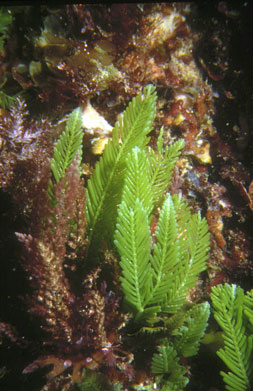 Examples: Chlorella,
  (motile spores). Sexual reproduction is very common and may be
isogamous (gametes both motile and same size); anisogamous (both motile
and different sizes - female bigger) or oogamous (female non-motile and
egg-like; male motile). Many green algae have an alternation of haploid
and diploid phases. The haploid phases form gametangia (sexual
reproductive organs) and the diploid phases form zoospores by reduction
division (meiosis). Some do not have an alternation of generations,
meiosis occurring in the zygote.
(motile spores). Sexual reproduction is very common and may be
isogamous (gametes both motile and same size); anisogamous (both motile
and different sizes - female bigger) or oogamous (female non-motile and
egg-like; male motile). Many green algae have an alternation of haploid
and diploid phases. The haploid phases form gametangia (sexual
reproductive organs) and the diploid phases form zoospores by reduction
division (meiosis). Some do not have an alternation of generations,
meiosis occurring in the zygote. 
 Chlorella